The Double Escape Hatch: How Schott Glass and Ericsson Reshaped the Abuse of Dominance Enforcement under the Competition Act, 2002
COMPETITION LAW
Shivam Singh and Priyanshi Jain
6/8/20269 min read
I. Introduction
Somewhere in a law firm in Delhi right now, a partner would be drafting and suggesting to his dominant company client. The piece of advice is probably quite short. It would roughly suggest: first, make sure the evidence of abuse of dominance is weak; second, if that fails, call your counterpart and settle the dispute.
This is a fair summary of what two landmark Supreme Court ("SC") rulings delivered just four months apart have together done to Section 4 of the Competition Act 2002. Taken individually, each judgement is defensible. However, taken together, they have accidentally created a double escape hatch for dominant firms that no one has confronted till now.
The issue which this blog addresses is that the combination of CCI v. Schott Glass India Pvt. Ltd. (2025 INSC 668) and CCI v. Telefonaktiebolaget LM Ericsson, SLP No. 25026/2023 decided in May and September 2025 respectively has together produced a two-stage escape rouge for dominant firms: first, challenge the evidentiary burden and almost certainly win; second, if the evidence somehow survives, privately settle with the informant and walk out of the courtroom. That the hatch exists at all is an accident of jurisprudence. That no one has mapped it yet is a gap this blog intends to fill.
II. The Evidentiary Trap in the case of Schott Glass
On 13 May 2025, the SC handed down its judgment in Competition Commission of India v. Schott Glass India Pvt. Ltd. (2025 INSC 668). The case had been crawling through the system since 2010, when Kapoor Glass complained that Schott, the dominant manufacturer of borosilicate glass tubing used in pharmaceutical packaging, was deploying a web of exclusionary rebates, discriminatory conditions, and supply refusals to squeeze out competition.
The CCI in 2012 agreed. It found abuse, imposed a penalty of ₹5.66 crore, and issued a cease-and-desist order. The erstwhile COMPAT in 2014 disagreed, found the evidence thin, and noted that Schott had been denied the right to cross-examine witnesses. The SC, fifteen years after the original complaint, agreed with the COMPAT.
The holding was important and, in isolation, was correct: it held that Section 4 doesn’t create strict liability. Dominance, per se, doesn’t attract penalties. The impugned dominant conduct must be shown to cause or be likely to cause an appreciable adverse effect on competition ("AAEC") in the market. As noted, the Court affirmed that "an assessment of actual or likely anticompetitive effects and objective justifications is required to conclude on conduct being anti-competitive.”
But here it gets complicated. The court held that in the absence of visible and substantial harm, an allegation of abuse of dominant position will not sustain; it also held that effects must be established by direct evidence such as economic data, demonstrated foreclosure, and market surveys. Critically, this theory rejected the CCI’s approach of inferring competitive harm from the structure of rebates without direct evidence of foreclosure or consumer injury. This is a high bar, set in a 2010 case involving the pharmaceutical tubing market.
The facts of the present case, as well as the countervailing factors, need to be considered for the analysis provided by the SC. The SC not only stated that there was insufficient evidence of AAEC, but at the same time, the SC accepted the countervailing factors considered by COMPAT, namely, converter growth, stable downstream prices, absence of foreclosure, etc., which dissipated the possibility of any AAEC. At the same time, there was also an issue of procedural defects – not allowing cross-examination of witnesses – which is a direct violation of the principle of natural justice, by which tribunals such as CCI are bound. This further brought scrutiny to the evidence relied upon by CCI. It has been held by a number of judgements that while tribunals such as CCI are not bound by strict rules of evidence, that doesn’t mean that they can adjudicate on no evidence or mere unsubstantiated allegations. The SC in the present matter reiterated the above stance, rather than establishing a more stringent evidentiary burden than what is already present in the Indian competition jurisprudence.
The question that the Court left entirely open and that has not yet been addressed, is what this standard means in fast-moving digital markets where competitive harm is dynamic, often invisible in the short term, and almost impossible to capture in the static market. This is a valid concern; the discussion on the Digital Competition Bill clearly discusses the use of ex-ante obligations to counteract any such harm.
The Schott Glass ruling has made the effects analysis mandatory but left the methodology entirely undefined. The CCI must prove effects. But how? What is the standard of burden? Who bears the burden? Using what tools? Assessed at what point in time? Against what counterfactual? The Court does not say. And in the gap between “effects are mandatory” and “here is how to prove them” lies enormous room for dominant firms to argue that the regulator simply has not met its evidentiary burden.
III. The Settlement Trap in the case of Ericsson
Four months later, on 2 September 2025, the SC dismissed the CCI's appeal in CCI v. Telefonaktiebolaget LM Ericsson (Civil Appeal No. 9726 of 2016), effectively approving the Delhi High Court's July 2023 judgment that had done two things at once.
The first was jurisdictional: the Delhi High Court held that the Patents Act, 1970 is a complete code governing licensing conditions attached to patents, and that the CCI therefore has no jurisdiction over a patentee’s exercise of its rights. The SC did not endorse this holding in terms; it expressly left these issues unaddressed by declining to interfere.
The second holding is the one that deserves far more attention. The SC agreed with the High Court's observation that “once a settlement has been reached between the informant and the person against whom the information is filed, the very substratum of the proceedings by the CCI is lost.”
This is where the issue begins. The CCI is not a private dispute resolution forum. It is an in rem regulator, meaning its proceedings serve the public interest in market competition, not merely the interests of whoever triggered the investigation. The SC itself confirmed this in Samir Agrawal v. CCI (2021) 3 SCC 136, holding that the CCI acts in rem and that any person, whether personally aggrieved or not, can initiate proceedings because the harm addressed is harm to the market, not merely to the complainant.
However, the 'substratum doctrine', laid down in the Ericsson case, inverts this logic entirely. It says that if the original complainant makes a private deal with the dominant firm instead of filing a case, a deal that is confidential, unreviewed by the regulator, and potentially includes a non-disparagement clause that simply replicates the original harm at a price that the complainant finds acceptable, the public interest case dies with it.
The Delhi High Court in JCB v. CCI (August 2024) applied the substratum principle to a non-patent abuse of dominance allegation, using particularly strong language to warn the CCI that its “over-involvement” post a private settlement would jeopardise the “finality that mediation aims to achieve.”
What makes the substratum doctrine particularly dangerous is its evolution beyond its original context, which was a bilateral patent licensing dispute in Ericsson involving FRAND royalty terms. Initially, the SC's view that settlements eliminate the substratum of the Competition Commission of India's (CCI) proceedings was justifiable in this specific case. However, the doctrine has since been misapplied as a universal principle, suggesting that any private settlement conclusively terminates the CCI's public enforcement role, irrespective of the broader market implications. The GMR-Air Works case exemplifies the appropriate response when market conditions are genuinely affected, as the CCI maintained its investigation grounded in established precedents, despite significant procedural challenges. These hurdles highlight the eroding enforcement capacity of regulators who must continuously defend their jurisdiction, even in clear cases of competitive relevance. The greater concern arises not from the actual Ericsson ruling, but from its detachment by subsequent courts that extend the doctrine to unrelated cases, such as the JCB v. CCI, without regard for broader competitive impacts.
A dominant firm facing a CCI investigation now has a clear playbook: identify the informant, negotiate a commercial settlement, and apply to the High Court for a quashing order. The settlement need not benefit consumers.
IV. Two Reasonable Decisions, One Unreasonable Outcome: The Double Hatch
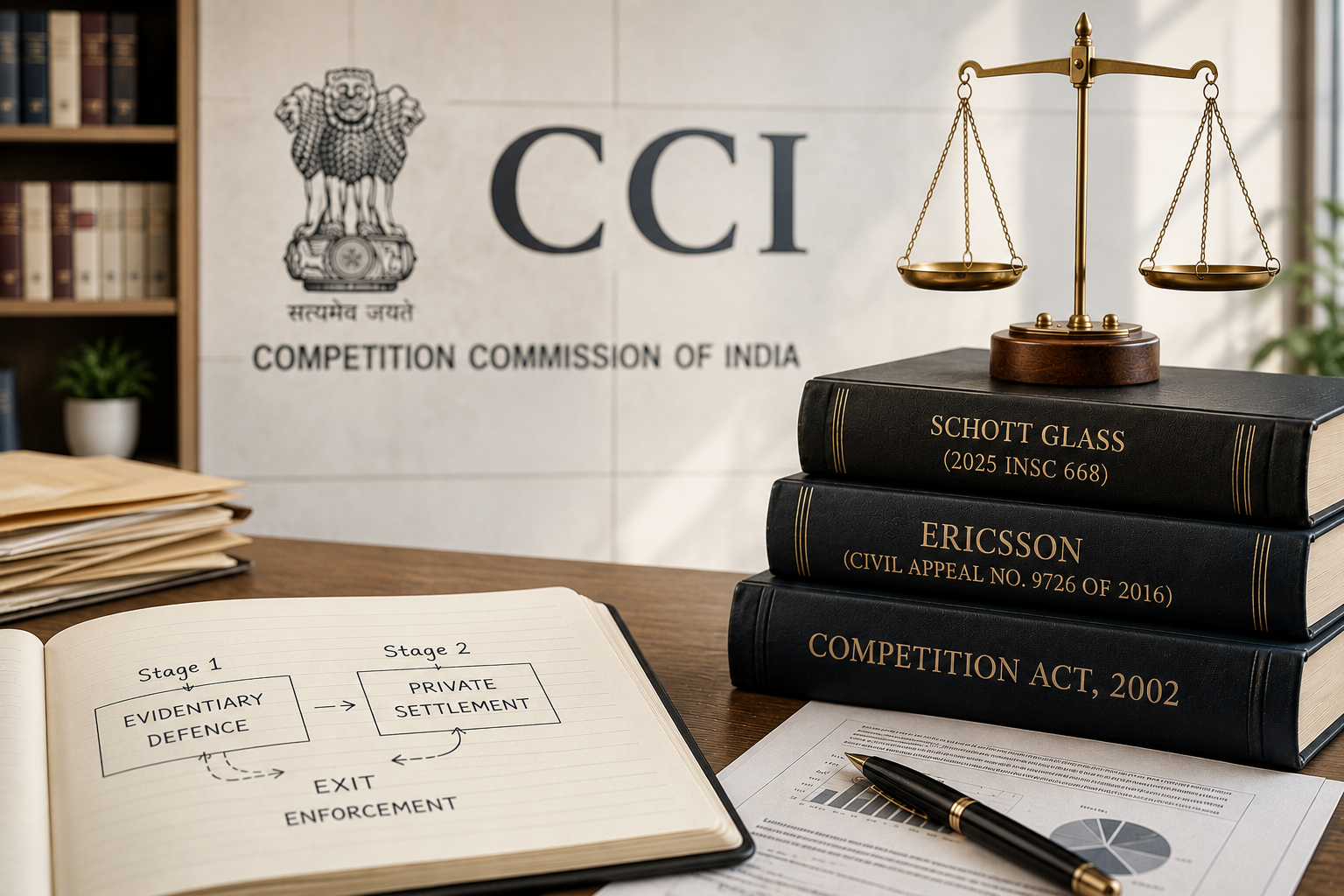
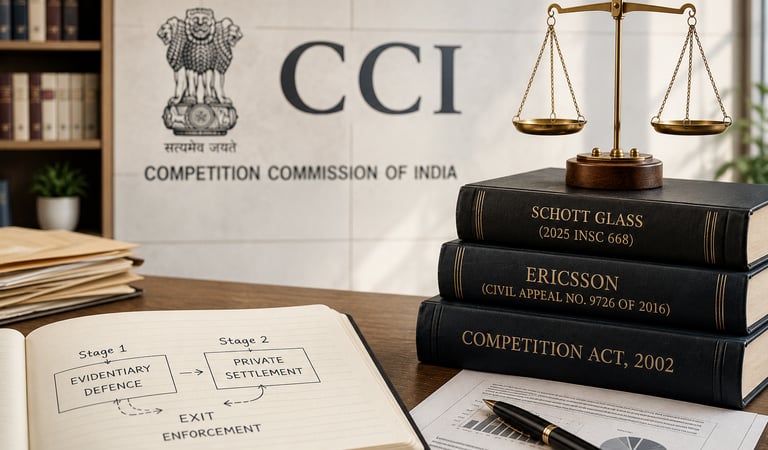
Read separately, Schott Glass and Ericsson each have a coherent logic. However, when read together, they create a two-stage escape mechanism for dominant firms that the legislature never intended, and the courts almost certainly did not foresee.
Stage I is the evidentiary defence. Post-Schott Glass, the CCI must conduct a rigorous, economics-based effect analysis to establish abuse. This requires gathering evidence for years together, requires substantial technical capacity and can be challenged at every step. A well-resourced dominant firm can absorb years of investigation while credibly arguing that the regulator has not met its burden. Given the CCI’s acknowledged capacity constraints and the DG office’s limited pool of economists, it gives a structural advantage to firms that can afford sophisticated expert testimony.
Stage II is the settlement trap. If Stage I fails, i.e. the CCI has somehow assembled compelling evidence, the firm can pivot to the informant. Settle privately, confidentially, generously. Pay whatever it takes to make the case go away. Then apply to the High Court, arguing that the substratum of the CCI’s proceeding no longer exists.
Between these two stages, there is no reliable pathway for the CCI to investigate and conclude an abuse of dominance case against a sufficiently resource-dominant firm willing to play both cards. But what about the AAEC in the market caused by such abusive conduct?
The GMR-Air Works case (September 2025) shows the tension in real time. In that matter, the CCI itself asserted correctly, drawing from Samir Agrawal, that its in rem mandate allowed proceedings to continue despite the informant’s withdrawal, because “the proceedings before the commission are not in the nature of a ‘lis’ between the parties, but are proceedings ‘in rem’, having implications on the market and its various constituents.” The CCI proceeded to investigate and ultimately dismissed the case on the merits, but notably, it took a Telangana High Court challenge, a stay, a withdrawn writ petition, and multiple rounds of litigation just to keep the investigation alive after the informant changed position. That procedural ordeal is itself evidence of how the substratum doctrine is being weaponised.
The Competition (Amendment) Act, 2023 introduced a formal settlement and commitment mechanism under Section 48A, precisely to give the CCI the power to resolve competition concerns with transparency and behavioural commitments. The legislature was thinking carefully about how to balance enforcement efficiency against finality. What was not contemplated was that firms might simply bypass the CCI’s formal settlement process entirely by settling privately with the informant and then walking into the High Court.
There is also a second gap that neither judgement addresses, which is the interaction between the effects-based standard and the type of harm that dominance causes in digital markets. The Schott Glass standard was developed in a case involving a physical manufacturing market, static market shares, and observable conduct in the form of discount schedules. The Court’s understanding of “hard evidence of effects” maps onto surveys, customer testimony, and observable foreclosure, which is traceable in traditional markets.
In Digital Markets, platform tipping, data-driven exclusion, self-preferencing, and cross-market leveraging, the harm is often prospective, systemic, and impossible to quantify in static terms. The CCI's current investigations into Google's Play Store billing practices (still alive after the Madras High Court's 2025 rulings), Amazon and Flipkart's e-commerce conduct, and any future case involving the quick-commerce oligopoly will all now need to navigate a Schott Glass effects analysis designed for a pharmaceutical tubing dispute from 2010. As the Ericsson saga "has redrawn the boundaries of antitrust enforcement in India", the full consequences of doing so in combination with Schott Glass have not been traced.
V. What needs to Happen
Three things need to happen, and none of them requires waiting for the Digital Competition Bill.
Firstly, the SC needs to define what “effects evidence” looks like in digital markets specifically. The Section 19(4) factors, such as market barriers, consumer welfare, and innovation effects, provide statutory hooks for a richer and more forward-looking effects methodology. The Court in Schott Glass cited these provisions as support for effects analysis but did not explain how they operate in markets characterised by network effects, tipping, and data-driven exclusion. The NCLAT's ongoing Google proceedings are the most likely vehicle for this clarification.
Secondly, the Competition Act needs an explicit provision, whether by amendment or through the CCI’s own procedural rules, that formally insulates ongoing investigations from private settlements where the conduct at issue has systemic, market-wide implications. The distinction between in-rem and in-personam proceedings, clearly established in Samir Agrawal, should do this work. What is needed, therefore, is not legislation to fill a gap that the Legislature overlooked, but rather authoritative judicial or regulatory clarification that brings the lower court application of the Ericsson substratum doctrine back into alignment with the existing in-rem framework.
Thirdly, the CCI needs to build the evidentiary infrastructure that Schott Glass now demands. This means the active deployment of its existing professional capacity, including the economists and Company Secretaries already on its roster, into investigations from the outset, alongside access to market modelling tools, so that effects evidence is built into the investigation design rather than assembled retrospectively. The 2025 AI Market Study demonstrates that the CCI is capable of commissioning serious market analysis. The question is whether it can embed that capability into its enforcement process before the double escape hatch is fully exploited.
VI. Conclusion
The case of Schott Glass was correctly decided. Effects analysis is the right standard. Ericsson has also correctly held that competition proceedings should not be pending indefinitely over parties who have resolved their private dispute. But the interaction of these two rulings in a legal environment where the CCI has limited econometric capacity, dominant firms have deep pockets and private settlements leave no public record, creates a structural enforcement deficit that will take years and several dominant firms’ abusive conduct to be escaped enough to create adverse effects in the market to be fixed.
The machine, in this case, is not merely an algorithm but a common practice itself, which has quietly learned through two perfectly reasonable individual decisions that the dominant firm now has a strategy that works. The dangerous legal loophole is the one created by two pieces of good law that nobody thought to read together.
About the Author
Shivam Singh and Priyanshi Jain are fourth-year law students at the Dharmashastra National Law University, Jabalpur.
Editors
Suprava Sahu, Senior Editor
Nupur Trivedi, Assistant Editor